Beyond Likes. Into Sales.

You know the stack. A UTM builder, a Google Sheet that updates itself, and Triple Whale on the other end calling it influencer ROI. It works right up until your founder asks which creator drove the sale. Then the room goes quiet.
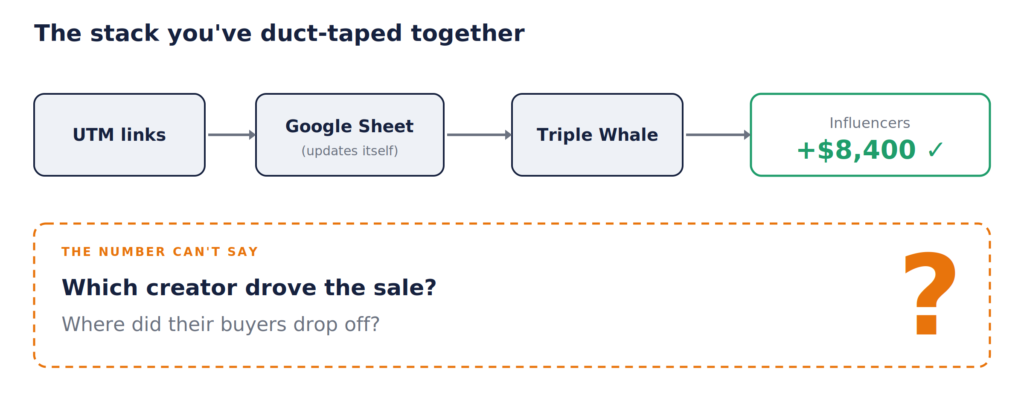
If that landed, you already live this. You are running fifteen, thirty, maybe fifty creators out of a store you also run. Nobody handed you a measurement system, so you built one out of the parts you had. This is about the one job that stack cannot do, why it cannot do it, and what sits next to it to close the gap — without ripping anything out, and without pretending the numbers are bigger than they are.
The stack you’ve probably duct-taped together
It usually grows in the same order. First you just gifted product and hoped. Then a few creators actually moved units, so you wanted to know which. You started tagging links — a UTM on the end of each creator’s URL so the traffic showed up labelled in your analytics. That got messy fast, so you built a Google Sheet. Maybe it pulls the numbers in on its own now. Maybe it is a Zap, or a connected sheet, or a Sunday-night copy-paste you have stopped admitting to.
Then Triple Whale arrived and tied the room together. It gave you a single, blended view of the business and, somewhere in there, a number for the influencer channel. So the pipeline became: tagged links in, Sheet in the middle, Triple Whale at the end calling it influencer ROI. One operator described their version almost exactly like that — a link builder, an auto-flowing sheet, Triple Whale on the end — and said it finally gave them “the real ROI per influencer.” Instant clarity. Justification for the spend.
It is a genuinely clever bit of duct tape. You should not feel silly about it. You built a reporting system because the tools you were sold did not give you one. The problem is not that the stack is dumb. The problem is what you quietly do every Monday to keep it alive, and the one question it still cannot answer when it matters most.
What your Triple Whale influencer ROI number actually tells you
Let’s give it full credit, because half-credit would be dishonest and you would smell it.
Triple Whale is a blended, whole-business tool, and a good one. It pulls your channels together — paid, email, organic, influencer and tells you how the business is performing as one machine. When it tells you the influencer channel returned, say, a 3.1x last month, that is a real and useful sentence. It means money went in and more money came out across all your creators combined. For a board update, for a gut check on whether the channel earns its place at all, for a blended ROAS you can put on a slide, that number does its job.
So this is not a Triple Whale takedown. Keep it. It answers “is the channel working” better than a spreadsheet ever will, and that is a question worth answering.
But look hard at the shape of the number. It is the channel. Every creator you work with, mashed into one figure. “Influencers: +$8,400.” That single number is the sum of your best creator, your worst creator, and the eight in the middle you cannot tell apart. It is an average wearing a dollar sign. And you cannot pay an average. You pay individual creators, individually, every month so the decision you actually have to make lives at a level of detail the blended number deletes by design.
The question it quietly can’t answer: which creator drove the sale
Take a normal week. Three creators post. One sale lands in your Shopify admin. Your Sheet does its thing and reports “influencers: +$420.” Tidy. You close the tab.
Now ask the question that decides where next month’s money goes. Which creator drove the sale? And what did the other two actually do?
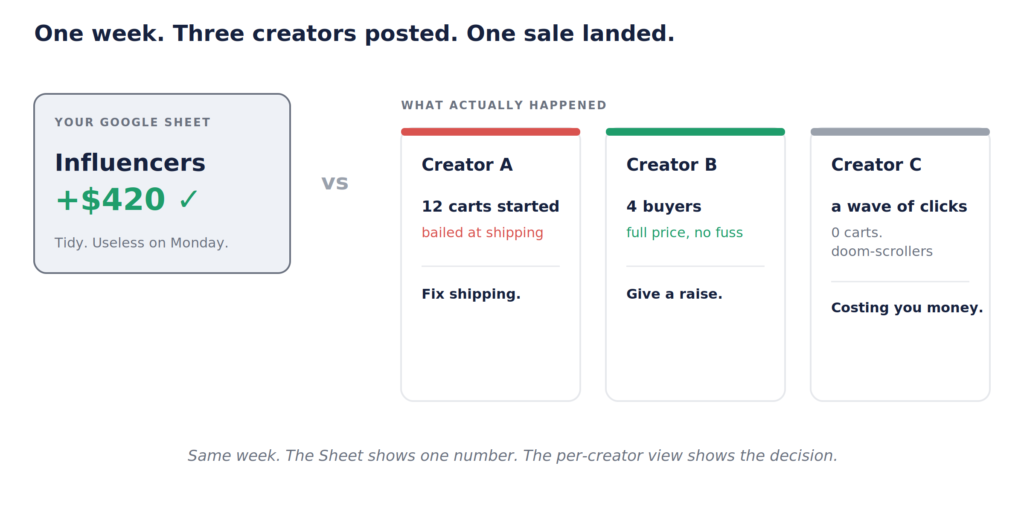
Here is what really happened that week, underneath the +$420.
Creator A sent a flood of traffic. Twelve of those people liked what they saw enough to start a cart and then twelve of them quit at the shipping step. Twelve carts, gone at the exact moment they saw postage. That is not a bad creator. That is a creator who brought you twelve people who wanted the product and balked at one line item. Fix the shipping offer for their audience and you might convert most of them next time.
Creator B brought four people who bought. Full price. No code, no fuss, no hand-holding. Quiet, unflashy, and responsible for the actual money.
Creator C brought a wave of clicks who opened one product page and bounced. Lovely engagement on the post. Zero carts. Doom-scrollers people who tap because the content is nice and would never buy.
The Sheet sees one thing: +$420. It cannot see the twelve abandoned carts, the shipping step, the four real buyers, or the wave that went nowhere. So next month, with nothing but +$420 to go on, you do the only thing you can: you pay all three roughly the same, again. You treat a creator who needs a shipping tweak, a creator who deserves a raise, and a creator who is costing you money as if they were the same line item. They are not. And the spreadsheet will never tell you which is which.
The slow, expensive version of the same mistake
The single-week story is the small version. The expensive version plays out over months, and it goes like this.
Because the only per-creator signal you can scrape together is “did a sale show up under their tag,” you start judging creators on that. The ones with direct sales look like winners. The ones without look like dead weight. So you cut the dead weight. Reasonable, on the face of it.
Except buyers rarely buy on the first touch. Someone sees Creator A, follows you, sees Creator B a fortnight later, and finally buys after a third nudge from Creator C. Your tag-based view hands the win to whoever was last and erases the two who built the intent. So the “dead weight” you just cut was often the top of your own funnel — the creators whose only job was to put people into the journey in the first place. You cut them. A month later your conversions sag and you have no idea why. You did not have a bad-creator problem. You had a measurement problem that made good creators look bad. The Sheet didn’t just fail to help; it actively pointed you at the wrong people.
Why Triple Whale can’t do this and why that’s fine
It would be easy to read all this as “Triple Whale is broken.” It is not. This is a question of what a tool is built to do.
Triple Whale is a wide-angle lens. Its whole value is pulling everything back far enough to see the entire business in one frame. Following a single creator’s link deep into your store every product that creator’s traffic opened, every cart they started, the precise step their buyers quit, whether each visitor was a buyer or a scroller is the opposite job. That is a macro lens. Asking the wide-angle to read that fine print isn’t a fair test of it. You would not fault a telescope for being a poor microscope.
So the honest framing is not “Triple Whale failed.” It is “you have two different jobs and you have only been using the tool for one of them.” The blended job: handled. The per-creator job: still open. That open job is the whole reason your Monday looks the way it does.
What goes next to it: the per-creator funnel
What you actually want is the thing Triple Whale is too wide to show the funnel for one creator at a time, from the click to the Buy button.
Concretely, that means seeing, for each individual creator: how many of their clicks opened a product, how many of those added to cart, how many reached checkout, and how many bought. Four steps, per creator, with the step where their people fall away showing in plain sight. That is the view that tells you Creator A’s buyers died at shipping rather than leaving you to guess. It is the difference between “Creator A: no sales, cut them” and “Creator A: twelve carts lost at postage, fix the offer.”
That is what Winfluencer’s creator analytics app is built to do, and it sits beside Triple Whale rather than replacing it. A few things make it hold up where the Sheet leaks:
It follows each creator’s link server-side, for a 90-day window. In plain terms: it counts the sale even when the buyer is on Safari or an iPhone, where ordinary pixels lose people to the “direct” bucket and your Sheet quietly under-reports. And it does it without discount codes, so there is no code for a buyer to forget and no leak to plug.
It reads per creator, not blended the four-step funnel above, for every creator, side by side. The drop-off step is the point. That is where your money is hiding.
It sorts your creators into the ones who first caught the buyer’s eye and the ones who got them to actually buy two different jobs that deserve two different pay structures. The creator who fills the top of the journey should not be judged on closing sales, and the creator who closes should not be paid as if they did it alone.
And it is free no per-creator fees. That last part matters more than it sounds, because the thing every operator dreads about the big platforms is the bill that grows every time you add a creator. Adding your fortieth creator here costs the same as your fourth: nothing. It installs from the Shopify App Store in about sixty seconds, no code.
Your Monday, rebuilt
Picture the two Mondays side by side.
The Monday you have now: you open the Sheet. You check the links resolved. You patch the row that broke. You reconcile it against Shopify because the totals never quite match. You build a tidy summary so that if anyone asks, you have a number. Twenty, thirty minutes of glue work before you have learned a single new thing. And at the end, the only verdict you can give is “the channel did okay.”
The Monday with the layer next to it: you open the per-creator view. Creator A — twelve carts, lost at shipping. You note to test free shipping for their next post. Creator B — four clean buyers, your quiet closer; you message them about a longer deal. Creator C — all scroll, no cart; you do not rebook them. Three real decisions, made from what you can see, in the time it used to take just to make the Sheet presentable. The blended number still lives in Triple Whale for the board. The decisions now live somewhere you can actually act on them.
That is the whole pitch, really. Not “more data.” Fewer Monday mornings spent rebuilding a spreadsheet to learn less than you needed.
If you’re running that creator content as Meta ads
One more place the same gap shows up, if you take creator content and run it as paid.
Meta will show you per-creator funnel detail only once someone converts. Everyone before the conversion — the carts, the near-misses, the people one nudge away — is a blur inside a blended ad metric. So the question “which creator’s content actually pulled buyers, and where did the rest fall off” goes unanswered in paid for exactly the same reason it goes unanswered in your Sheet: the tool is reporting at the channel level, not the creator level. The same click-based, per-creator view fills that in for the traffic it can follow. It does not magically see everything Meta hides — nothing does — but for the clicks it can follow, you get the earlier picture paid normally denies you.
Keep both. This is a layer, not a replacement.
To be completely clear, because the last thing you need is another rip-and-replace project: you do not remove anything. Triple Whale stays exactly where it is, doing the blended, whole-business number it does well. The creator layer goes next to it, doing the per-creator number Triple Whale was never built for. One answers “did the channel work.” The other answers “which creator, and where did their buyers go.” They are not competitors. They are two lenses for two questions, and you want both.
The honest limit — read this before you install
Here is the part most tools would bury, and the part that should make you trust the rest.
It follows the clicks it actually saw. It never guesses. So if someone watches a story, screenshots your product, and two days later types your brand into Google and buys — no click, no credit. That sale will not appear against the creator who really caused it, because there was no trackable click to follow. You are trading a sliver of dark-social coverage for numbers you can defend.
That trade is deliberate, and we think it is the right one. A slightly smaller number you can stand behind in a QBR beats a bigger number you quietly invented. When your founder pushes on a figure, “this is every sale we could follow from a real click, server-side, over ninety days” is an answer that holds. “Our model estimates” is not, and you know it the moment you say it out loud. So if your totals do not match Shopify or GA4 to the dollar, that is exactly why — and it is the honest version, on purpose.
Frequently asked questions
How do I actually know which creator drove the sale? You follow that creator’s link, server-side, all the way to the Buy button, and you look at the per-creator funnel — product views, carts, checkouts, purchases. A blended channel number cannot tell you; a per-creator funnel can.
Why won’t Triple Whale break out individual creators? Because it is a blended, whole-business tool. Per-creator funnel detail was never the job it was built for. That is a scope fact, not a fault.
Do I have to stop using Triple Whale? No. This sits next to it. Triple Whale keeps doing the blended number; the creator layer adds the per-creator one.
Is there something Shopify-native, or am I stuck stitching UTM sheets forever? There is. It installs from the Shopify App Store in about sixty seconds, follows each creator’s link without discount codes, and replaces the Monday spreadsheet work.
Why don’t the numbers match Shopify or GA4 exactly? Because it only counts sales from clicks it actually saw and never estimates the rest. You lose a little no-click coverage and gain a number you can defend.
What does it cost? It is free, with no per-creator fees — so a growing roster doesn’t grow your bill.
Stop rebuilding it every Monday
You already built the influencer ROI system by hand, and it got you a real channel number. This is the part you couldn’t build: which creator drove the sale, and where their buyers dropped. See it per creator — free on Shopify, sixty seconds, no code.