
Beyond Likes. Into Sales.
How to Track Influencer Sales - The Definitive Guide (2026), When Every Tool Is Lying to You
We tested 12 platforms. None solved it. Here's what we found.
It's 7:40am. The Email Lands.
You're mid-coffee. Your phone buzzes.
It's the CFO at your biggest client.
Or maybe it's your own CFO. One floor up.
"Ahead of Thursday's review, can you send over the influencer CPA broken out by creator? We're comparing all channels."
Your gut drops.
Your Meta ads show 4.5x ROAS. Google shows 3.8x. Email? Tracked to the cent.
Your influencer line shows… reach. Likes. A messy sheet of codes.
You know the codes only tell 30% of the story. Maybe less.
You know the campaigns work. You can feel it in the revenue data.
But you can't prove it with a clean number.
And "I can feel it" doesn't survive a budget review.
If you run an agency, this is the email that costs you clients.
If you run it in-house, this is the meeting that kills your budget.
Both feel the same. Dread. Then panic. Then hours of stitching data from five tools that don't talk to each other.
You are not alone in this.
$32.55B — Influencer marketing in 2025. Growing 33% per year.
79% — Of marketers say ROI is their #1 challenge.
48% — Point to attribution as the biggest gap.
80%+ — Still track in spreadsheets.
This is six months of research. Twelve platforms tested. Hundreds of reviews read. And a truth the industry doesn't want you to see.
Every tool has the same blind spot.
Let me show you.
Your Discount Codes Are Lying to You
Codes are simple. Give each creator a code. Count the sales. Done.
64% of brands track this way. It's the easiest start.
It's also a trap.
Honey is eating your data
Browser tools like Honey scrape codes the moment they go live.
They serve those codes to anyone at checkout. Even people who never saw the creator's content.
The cost? $300 to $600 million per year for US brands.
81% of this abuse goes unseen.
So when your code shows 400 sales, how many came from the creator? How many from Honey? You don't know. No one does.
You're paying the wrong people. Losing margin. Building strategy on bad data.
One DTC founder called Honey "a death sentence for a brand."
Codes miss the best buyers
Here's what codes can't see.
The person who watched the Reel. Googled your brand. Bought at full price. No code used.
That's your best buyer. High intent. Full margin.
And they're invisible.
Surveys show influencer impact is 2–3x higher than codes capture. The 60–80% who buy without a code? They don't exist in your data.
UTM Links Break Where Creators Post
UTM tags feed into GA4. They're free. They're mature. They should work.
But they crash into one wall: most posts can't hold a link.
No link, no data
Instagram feed posts? No link. TikTok captions? No link. Reels? No link.
UTMs only work in Stories and YouTube links. That's a tiny slice of content.
Dark social eats the rest
Up to 84% of shares happen in DMs, texts, and WhatsApp. When someone copy-pastes a link and sends it, the UTM tags get stripped.
GA4 sees it as "direct traffic." Not as the creator who drove it.
65–70% of web shares come from copy-paste. Your channel data is fiction.
Safari kills what's left
Safari holds 51% of US mobile use. It deletes first-party JS cookies after 7 days.
If your buyer takes a week to decide, the trail is gone.
iOS 26 now strips click IDs too. Each update makes it worse.
60–70% of mobile traffic is now invisible to old tracking. For a channel that lives on phones, that's fatal.
Affiliate Links Are Losing Creator Trust
Give each creator a link. Drop a cookie. If they buy within 30 days, the creator gets paid.
Sounds fair. It's not.
Last-click steals the credit
Buyers touch a brand 7–12 times before they buy. Last-click gives all the credit to the final touch.
A coupon site that jumped in at checkout? Full credit.
The creator whose video started the whole journey? Zero.
This is the model ShopMy uses. SARAL too. Standard last-click. 30-day windows. Broken by the same forces.
Honey stole creator revenue
In late 2024, PayPal's Honey was caught swapping creator links for its own. Lawsuits followed.
Only 9% of creators say they're happy with commission-only deals. 41% avoid them.
When the tracking itself can be hijacked, who trusts the data?
The Privacy Wall Is Closing. There's No Going Back.
Every tool above depends on cookies and browser-side scripts.
Browsers are killing both.
Safari caps JS cookies at 7 days. 24 hours from tracked domains like Meta.
96% of iOS users opted out of tracking.
Meta had to shrink its own window from 28 days to 7.
iOS 26 strips click IDs. Firefox blocks third-party cookies.
19 US states now have privacy laws.
The trend is one-way. More walls. Less data. Fewer hacks.
Each month without better tracking is data you can never get back.
Double-counting makes it worse
One study: 200 real sales. Meta claimed 180. Google claimed 150. TikTok claimed 75.
Total: 405 phantom sales from 200 real ones.
Each platform counts the same buyer. None share data.
Your influencer content gets lost in the noise.
We Tested 12 Platforms. Here's the Truth.
Every platform says "full-funnel tracking." We checked.
Twelve tools. Four types. Same blind spot.
Enterprise tools: GRIN, CreatorIQ, Aspire
These are the big names. Great for managing creators. Poor at proving sales.
GRIN — $25,000–$33,000/year
190M+ creator database. Deep Shopify link. Strong at workflows.
But it tracks sales with client-side JS and codes. Not both at once.
User reviews call it out: codes leak to Honey and inflate the numbers. No server-side tracking. No view-through data. No multi-touch.
11 G2 reviews flag "Poor Reporting." Users export to Excel for real answers.
The dashboard shows reach and revenue side by side. But they're not connected. Two streams. No bridge.
CreatorIQ — $30,000–$90,000+/year
Built for Fortune 500 brands. Disney. Unilever. LVMH.
Sales tracking? It routes through outside networks: Awin, Impact, Rakuten.
No native pixel. No server-side data. Its Shopify app has zero reviews.
One user waited seven months and said the Shopify link was "not ready yet."
Great at awareness. Weak at proving revenue.
Aspire — $12,000–$42,000/year
170M+ creators. Big marketplace. Solid Shopify app.
But the tracking uses client-side JS with a 30-day window. Last-click only.
On Safari, that 30 days becomes 7. Or 24 hours from Meta.
Here's the tell: Aspire's own docs say to pair it with a server-side tool for better data. When a platform tells you to buy another tool, that says it all.
Attribution tools: Triple Whale, Hyros, Northbeam
These tools nail paid ad tracking. But they can't see creators.
Triple Whale — $179–$4,490/month
Tracks $30B+ in Shopify revenue. 50,000+ brands. Seven attribution models.
Ask it one question: "Which creator's organic post drove this sale?"
It can't answer.
If someone watches a Reel, Googles you, and buys — Triple Whale calls it "Direct." Not the creator.
It has no link to creator social accounts. It pulls no engagement data. No likes, saves, or shares.
It solves paid ads. It leaves influencers blind.
Hyros — $230–$369/month
Real server-side tracking. Tracks buyers for years. This is the closest to what influencers need.
But it was built for info-product sellers. Tony Robbins. Grant Cardone.
No social data. No creator features. No way to link a sale to a Reel or TikTok.
Its SPAC deal fell apart in 2023. Reviews are thin with harsh outliers.
Northbeam — $999–$2,500+/month
ML-based attribution for $40M+ DTC brands.
It calls influencer marketing a "Non-Integrated Channel." Same bucket as direct mail.
Tracking? Manual UTMs. Manual spend uploads via spreadsheet.
Its model actually pushes down organic and branded search when it sees any paid ad touch. So if a creator drove the visit but the buyer also clicked a Meta ad, the creator's credit vanishes.
VC-backed upstarts: Agentio, ShopMy, SARAL
Big funding. Big hype. Same gap.
Agentio — $340M valuation
Automates YouTube ad buys. Uber, DoorDash, Warby Parker use it.
But it's still hiring its first measurement lead. No tracking pixel. No Shopify link. YouTube only.
ShopMy — $1.5B valuation
185,000 creators. $1B+ in sales. Strong Shopify tie.
But it uses the same last-click cookies as legacy networks. 30-day window. Honey overwrites it.
And — this matters — it does not support agencies. No multi-brand view. No agency dashboard.
If you manage more than one brand, ShopMy isn't an option.
SARAL — $12,000–$25,000/year
Clean UI. Fast setup. Good for small teams.
But it farms out tracking to GoAffPro, a free Shopify app. Its own site says it's "not optimised for tracking purchases from influencer-run ads."
G2 reviewers say analytics are "limited or in development."
Affiliate networks: Impact.com, CJ, Rakuten
These have server-side tracking. Real CNAME routing. Cookieless matching.
But influencer is a bolt-on.
Impact.com — $30–$2,500+/month
Best tracking tech in this list. Server-to-server. Cross-device matching.
But only 80,000 creators. G2 users flag 162 mentions of "Not Intuitive." Complex DNS setup.
Built for affiliate programs. Creator features feel like an add-on.
CJ Affiliate and Rakuten
CJ is the world's biggest affiliate network. Rakuten has server-side as default.
But their influencer tools come from partners, not native. Social data is limited. Pricing is hidden. Onboarding is slow.
Enterprise tools with influencer as an afterthought.
The Gap Nobody Has Filled
Here's what we found after six months.
No single tool combines these five things:
1. Server-side tracking. Not browser JS that Safari kills. Real HTTP cookies through CNAME routing. Only Hyros and the affiliate networks do this — but none for influencer content.
2. 90-day attribution. Influencer content has a long tail. Standard windows are 7–30 days. That misses 70% of the value.
3. First-party cookies via CNAME. Not third-party cookies being blocked by every browser.
4. Engagement and revenue in one data model. Not two streams in one dashboard. One model that connects likes to sales.
5. Bridge metrics. Engagement-to-conversion rate. Revenue per 1,000 impressions. Content quality score. Zero out of 12 platforms have this.
| Capability | Who Has It? |
|---|---|
| 90-day attribution (native) | Only Hyros (for ads). Rest: 7–30 days. |
| Attribute organic posts to sales | None. All need a UTM click or code. |
| Bridge metrics (engagement → revenue) | 0 out of 12. |
| Agency-first multi-client design | 0 out of 12. |
| Automated DNS for fast onboarding | 0 out of 12. |
| Mid-market pricing ($200–$1K/mo) | Only Triple Whale base and Hyros. Neither for influencer. |
The pricing gap is just as wide
Enterprise tools: $24,000–$100,000+/year. Annual contracts.
Attribution tools: $2,000–$6,000/year. Built for ads.
The $200–$1,000/month range? Where agencies and scaling brands live?
Empty.
GRIN's cheapest deal is ~$15,200/year. CreatorIQ starts at $30,000. Even SARAL is $12,000.
If you manage 8–25 clients on $3K–$12K retainers, none of these fit.
If You Run an Agency, This Is Your Life
You have 5–25 people. $500K–$5M in revenue. 8–25 clients. 50–300 creators.
Too big for spreadsheets. Too small for $35K tools.
The monthly reporting trap
Pull Shopify data. Check UTMs. Cross-check codes. Open GA4. Compare sheets. Build a deck.
For every client. Every month.
At 10 clients: 15+ hours. At 30: over 30 hours.
One agency said they spent 6–8 hours a day on this. Every day.
The industry calls it "Hell Week." The stretch when every client expects their report at once.
85% of you still track content in sheets. 71% track gifting in a second sheet.
This is not a reporting problem. This is a data problem.
The client you're about to lose
A $8K/month client leaves. That's $96K/year gone.
Two leave. You're in trouble.
The trigger is always the same. A QBR where the CFO asks for CPA per creator. You show engagement data. They want revenue data.
60% of practitioners present data they know is incomplete. They know it. The client senses it.
The agency across town has a dashboard
You open LinkedIn at lunch. A rival posted a screenshot. Clean ROAS per creator. Revenue by campaign.
You don't know if it's real. But it looks better than your sheet.
In the next pitch, they'll show data. You'll show slides.
You know who wins.
The pricing trap you can't escape
Flat retainers: $5K–$10K/month.
Performance pricing: retainer PLUS 10–20% of proven revenue.
That could double your income per client.
But you can't do it. Not without data you trust.
Agencies with proven processes sell at 8–12x EBITDA. Without them, you're stuck at 4x.
If You Run It In-House, This Is Your Career
66% of brands run influencer in-house. You're likely a team of one to three.
You proved the channel works. But you can't show how much.
The budget meeting that decides your future
Meta: 4.5x ROAS. Google: 3.8x. Email: documented.
Your line: reach. Saves. A chart of code redemptions.
45% of marketing managers face growing pressure to show value. That pressure grew 52% in two years.
When cuts come, the line without a number goes first.
You speak one language. Your CFO speaks another.
You say engagement rate. They want CPA.
You show impressions. They want ROAS.
Every other channel has closed this gap. Yours hasn't.
They might replace you with an agency
In-house management dropped to 23% among large brands. 49% now use agencies. Up from 28%.
When you can't prove ROI, the budget moves. And so does your role.
10–40 hours a month on manual tracking
One marketer priced it: 10 hours a week on tracking is $30,000+ a year in labour.
For data that's still half-wrong.
That's time not spent on creators, content, or strategy. The actual work.
What Actually Works: Server-Side Tracking Built for Influencer Marketing
The fix is not a better dashboard.
It's better plumbing.
How server-side tracking changes the math
Normal tracking lives in the browser. JS cookies. Pixels. Things Safari blocks.
Server-side tracking lives on your server. It uses HTTP cookies set through CNAME routing on your own domain.
These cookies look like any other cookie your site sets. Cart. Login. Session.
Browsers don't block them. Safari's 7-day rule only hits JS cookies.
Result: 60, 90, even 180-day windows. On every browser.
Studies show 18–40% more conversions captured versus browser-only tracking.
One major platform found 70% of value hid past day 7. Invisible to JS tools.
What this means in plain terms
A buyer sees a creator's Reel on Tuesday. She browses your store on Saturday. She buys three weeks later.
JS tracking lost her after 7 days.
Server-side tracking held the thread for 90 days.
The sale gets linked to the creator. The revenue shows up in the report.
That's the difference between "direct traffic" and "Campaign A drove $47,000 through Creator X."
How to Test Any Attribution Tool: 7 Questions
Use these. For any tool. Including ours.
1. Server-side or browser-side? Ask: "Does it survive Safari ITP?" If it needs a JS pixel on every page, it's browser-side.
2. What's the real attribution window? Not the max setting. The one that works on Safari for 51% of mobile users.
3. Can it track organic content? If a creator posts a Reel and the buyer Googles you, does the tool catch it?
4. Does it connect engagement to revenue? Not two charts in one view. One model. Bridge metrics.
5. How fast is onboarding per client? Manual DNS? IT tickets? 48-hour waits? Or minutes?
6. Is pricing clear? 72% of buyers prefer transparent pricing. "Contact sales" usually means enterprise.
7. Does it work with your stack? It should sit alongside GRIN, Aspire, Shopify, GA4. Not replace them.
What Changes When Attribution Actually Works
For agencies:
You walk into the QBR. The dashboard shows ROAS per creator.
Influencer CPA: $23. Meta CPA: $48.
The CFO's question shifts from "justify this" to "can we do more?"
You move to performance pricing. 10–20% of proven revenue on top of the retainer.
Your agency goes from 4x EBITDA to 8–12x.
You hire strategists, not data wranglers.
For in-house teams:
You show the CFO: "Influencer CPA is $23 versus $48 on Meta. Here's the dashboard."
Budget goes up. Not down.
You scale from 15 creators to 100. Each one tracked.
You stop building reports and start building strategy.
You become the person at the company who solved attribution.
Both paths lead to the same shift.
From defending the channel to growing it.
From guessing to knowing.
From hope to proof.
Where This Leaves You
We've covered a lot of ground.
Three tracking methods that fail in known ways. Twelve platforms with the same blind spot. A privacy trend that only gets worse.
And a gap: no tool combining server-side tracking, 90-day windows, bridge metrics, agency design, and mid-market pricing.
You might be wondering if anyone is building this.
After six months of looking for this solution, the uncomfortable answer was simple: we couldn't find one built the way agencies actually need it.
So we built it.
Winfluencer started because I sat in the same seat you're in.
I was a marketing data analyst. I watched influencer attribution break across client after client. I built the same messy sheets. I sat in the same meetings.
I started asking: what if you could do server-side tracking for influencer content the way Hyros does for ads? But built for agencies? At a price that doesn't need board approval?
That question became Winfluencer.
Here's what it actually looks like inside:
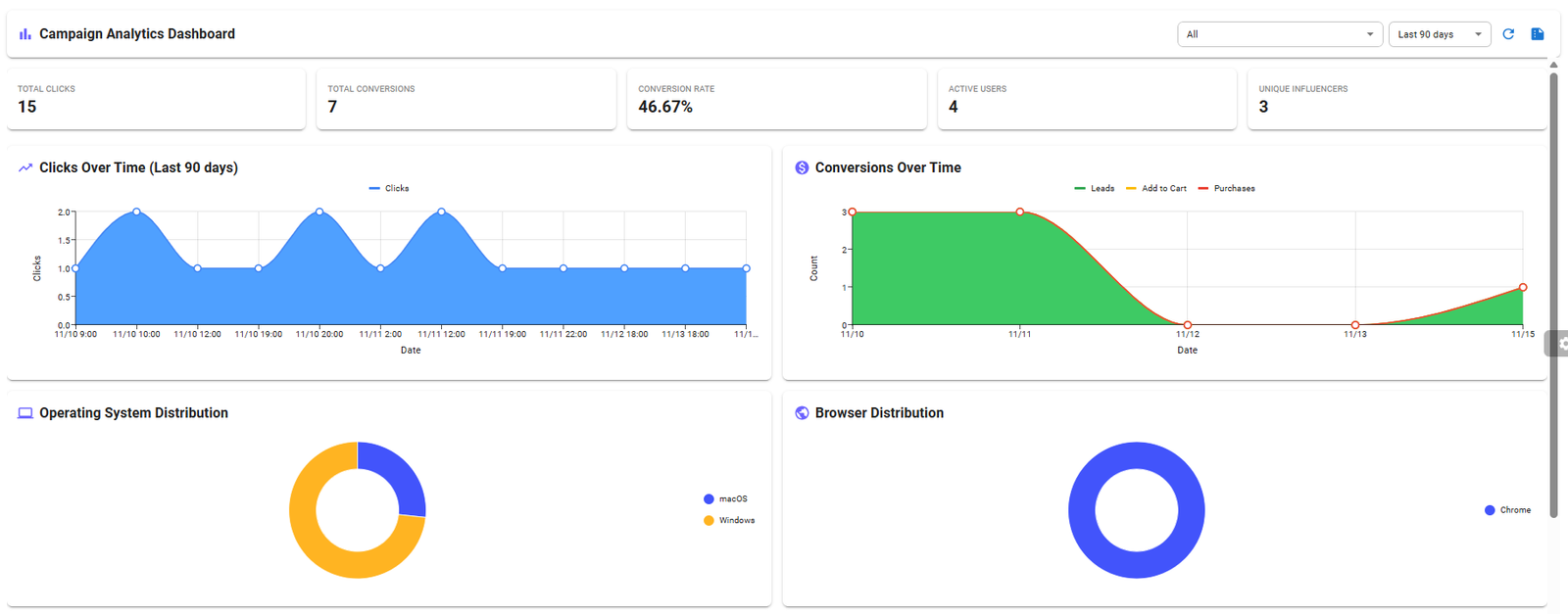
Campaign dashboard: clicks, conversions, and attribution tracked over a 90-day window.
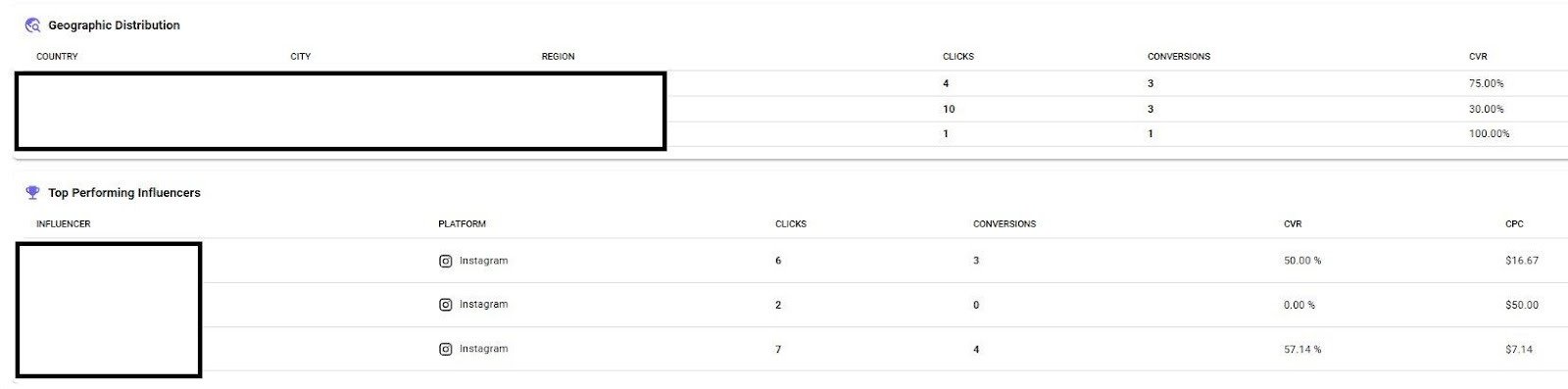
Per-creator breakdown: clicks, conversions, conversion rate, and cost per click — by influencer.
Server-side tracking through CNAME routing. 90-day windows. First-party cookies that Safari doesn't touch. A Shopify app. Bridge metrics no other tool computes. Built for agencies first, with in-house teams as a natural fit.
$200–$1,000/month.
Setup takes minutes, not weeks
1. Connect to Google Tag Manager. Add the Template. Takes under 5 minutes.
2. Set your CNAME. One DNS entry. We walk you through it.
3. See attributed data. First report within 24 hours. Not 6 weeks.
That's it. No IT tickets. No enterprise onboarding.
If this is the problem you're solving right now, two options:
Try it yourself. Start a free trial. Connect Shopify. See what shows up that your current tools miss. No contract. No pitch.
Or get a free attribution gap audit. I'm Randula. I built this. In 15 minutes, I'll walk through your current setup and show you exactly where influencer revenue is disappearing. No pitch. Just the gaps.
Either way, the gap between what your campaigns deliver and what you can prove they deliver gets wider each quarter.
The tracking won't fix itself. The privacy rules won't soften. The CFO email will come again.
The question is whether you'll have the numbers when it does.